Until recently, only professional photographers were likely to have access to an 800mm lens, which delivers 16x magnification on a full-frame camera. The best that amateur birders might have aspired to were a 500mm or 600mm lens; the only 800mm lenses were massive prime lenses with an equally hefty price tag. Canon broke the mould when it introduced its fixed f11 800mm lens in 2020, which was both more affordable and much more portable. However, it was not without its drawbacks; the minimum focus distance was six metres and the fixed aperture size was not ideal.
But perhaps the biggest challenge with a fixed 800mm lens is its lack of flexibility. It’s ideal when your subject is tiny or far away, but for many subjects it is often too much lens. I find that these days I seldom use even my f4 500mm zoom, even though it outperforms my 100–500mm lens in low light conditions, because I value the portability and versatility of Canon’s 100–500mm lens more than the greater aperture size of the big prime lens.
With these considerations in mind, I was excited to hear that Canon had released a 200–800mm RF lens for its mirrorless R-series cameras. Surprisingly, it costs slightly less than the brilliant 100–500mm RF lens. The reason for the lower price presumably is that although it is a ‘white’ lens, like all Canon’s premier telephoto lenses, it lacks the red ring of an L-series lens. This means it does not entirely meet Canon’s exacting standards for the construction and weatherproofing of its top-end lenses.
Image quality
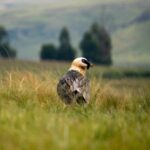
The lens coatings might also be slightly inferior, but this is barely perceptible; image quality in the new 200–800mm zoom is impressive. Unless you can get closer to your subject with the 100–500mm lens (which also reduces atmospheric interference), the greater reach of the 200–800mm lens is at least as good as the cropped image from the 100–500mm lens. And I found that the 200–800mm lens produced sharp images even at 800mm more reliably than Canon’s fixed f11 800mm zoom.
Aperture size
A concern for many people is likely to be the rather modest maximum aperture size, which starts at f6.3 at 200mm and shrinks to f9 at 800mm. In fact, the aperture size is similar to that of the 100–500mm f4.5–f7.1 lens, changing to f8 at 456mm and f9 at 637mm focal length. The modest aperture size means you are forced to push up the ISO when shooting in dim light, but with the latest R-series mirrorless bodies this still delivers acceptable images. Another possible drawback is that the greater depth of field results in ‘busy’ backgrounds. In fact, this is not much of an issue; the 200–800mm lens delivers smoother backgrounds than the 100–500mm.


Weight
As one might expect, the 200–800mm lens is larger and heavier than Canon’s 100–500mm. The 50 per cent greater length makes it less than ideal for travelling, but I found that at just over two kilograms, the additional 500 grams in weight was barely noticeable in the field. Having fewer elements than the 100–500mm lens, the 200–800mm is less dense and nicely balanced around the tripod foot when coupled with an R7 body. One slight drawback is you can’t remove the tripod foot from the lens.

Stabilisation and zoom
Image stabilisation for both still and video footage is excellent. I only used it handheld and found virtually every image to be sharp, even when shooting at slow shutter speeds, as long as the subject wasn’t moving. Compared to the 100–500mm zoom, the focus of the 200–800mm is a tad slower, possibly because it lacks the option to restrict the focus range, but the difference is barely perceptible. A more significant issue for some might be the longer and stiffer zoom action of the 200–800mm lens, but I soon got used to this. When birding, I tended to leave the lens set to about 400–500mm, to facilitate finding the bird in the frame, and then it was easy to zoom in to 800mm if desired.


Close focus
The other slight disadvantage of the 200–800mm compared to the 100–500mm lens is its close focus capability. Whereas the 100–500mm lens focuses close to one metre across its zoom range, the 200–800mm changes from 80 centimetres at 200mm to 3.3 metres at 800mm. This is still acceptable for almost all bird photography, but gives the 100–500mm lens the edge when it comes to butterflies and dragonflies.
Camera lens combo
For the past few years I’ve been recommending a Canon R7 with the 100–500mm zoom as a great combination for the birding photographer (someone who watches birds and wants to have the option to capture images of what they observe, as opposed to a dedicated bird photographer). Now I would probably advise the R7 and the 200–800mm zoom, although it’s a close call. If you’re using a full-frame body, the decision is easier: the longer reach of the 200–800mm lens is even more important, so this is likely to be your lens of choice.
To convert or not to convert
A more challenging question is posed to those who already have a 100–500mm lens. Should they swap that for the 200–800mm or keep it and use it with a 1.4x teleconverter to more or less match the capabilities of the new lens? That means spending an extra R12 500 on a converter and losing much of the convenience of an all-in-one lens option. Adding a converter to the 100–500mm lens extends its reach, but also greatly reduces its ability to capture birds in their wider environment because it prevents zooming out beyond 420mm with a 1.4x converter, or 600 mm with a 2x converter (and makes it almost as long as the 200–800mm lens).
Another benefit of the 200–800 mm zoom is that if you add a converter to it, its use is not restricted to longer focal lengths. With a 1.4x converter you get a 320–1120mm lens, which with a crop sensor on the R7 gives you an effective magnification of 10–36x! I didn’t have an RF converter to test this, but online reviews indicate that the 200–800mm lens still delivers sharp images with a converter.
At around R50 000, the 200–800mm RF lens is not exactly cheap, but it offers great value for money given its unprecedented zoom range and impressive performance. And when compared to other high-end lenses – Canon’s 800mm f5.6 lens at more than R400 000 or Nikon’s 800mm f6.3 lens at R150 000 – it begins to look decidedly affordable. I expect it will become a firm favourite with birding photographers.
Text and Photos Peter Ryan