Fiery-necked Nightjar
At a guess I’d say that about three quarters of birders in the region, wouldn’t ID with certainty, a Fiery-necked Nightjar 20 – 30 m away – assuming no nightjars were calling of course. They are not entirely to blame for this! Nightjars are a tough group, and historically, illustrations in publications haven’t been accurate, nor has the identification data been that useful! Time to rectify the problem!
There is, in my view, only one area on the bird that needs to be targeted: the lores and ear coverts. If you can pick these up in the field, and the region behind and in front of the eye is mottled, or plain rich brown in colour, you can be pretty sure that the bird is a fiery-necked.

If you are skeptical, view the following images, all show varying degrees of mottled rich brown feathering to the lores and ear coverts.

Ignore the white throat patches – those feathers are exposed when they’re about to call. Below: images where head angles aren’t exactly side-on, but the result is still the same!

The so-called ‘fiery-neck’ or nuchal collar is a useless ID feature, too variable and often hidden. The two other species in the region one might confuse Fiery-necked with, are Rufous-cheeked, and Square-tailed. Both have mottled sandy/brown, or greyish/brown feathering on either side of the eye, but neither are rich brown in that region.

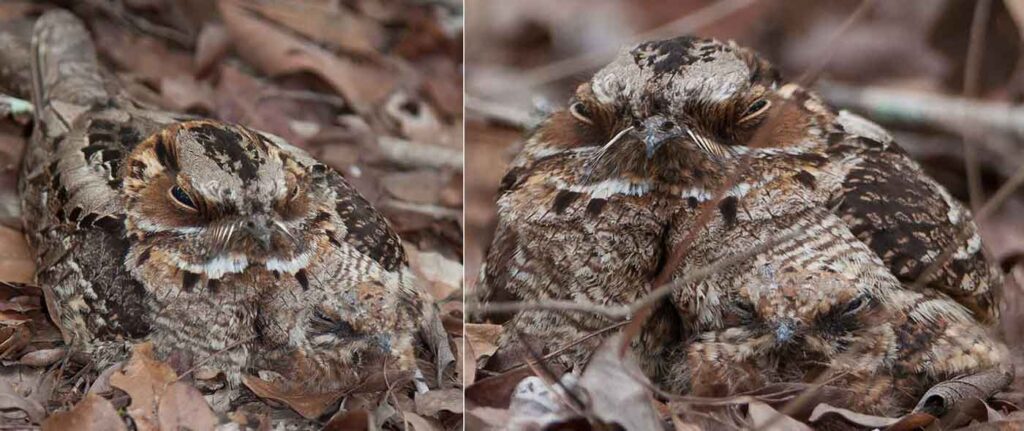
Below: In fresh plumage, some Fiery-necks may show prominent plain rich brown eye patches, such as the brooding female photographed in Mozambique (Dec. Note the chick that’s being brooded.
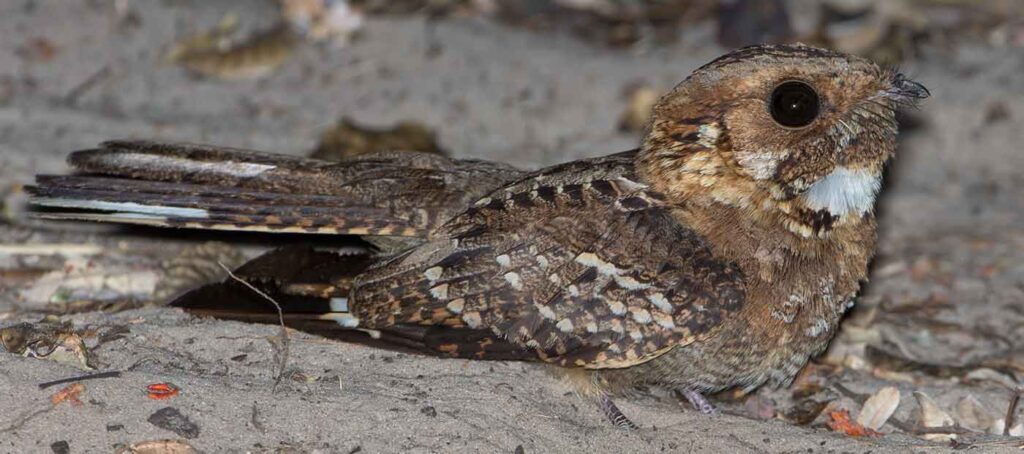
Below: Now moving on to show other examples of geographic variation, shelleyi below (Caprivi region – September) shows how rufous the sides of head, neck and upper breast region are.
Below: The darkest and largest subspecies pectoralis is essentially a Cape breeding species, but many of these birds move northwards into KwaZulu-Natal during the winter months to take advantage of better feeding opportunities (Mtunzini – May).

Below: Finally, the last of the recognised Fiery-necked subspecies in the region, fervidus. This one was photographed near Martin’s Drift adjacent the Limpopo River (Oct).
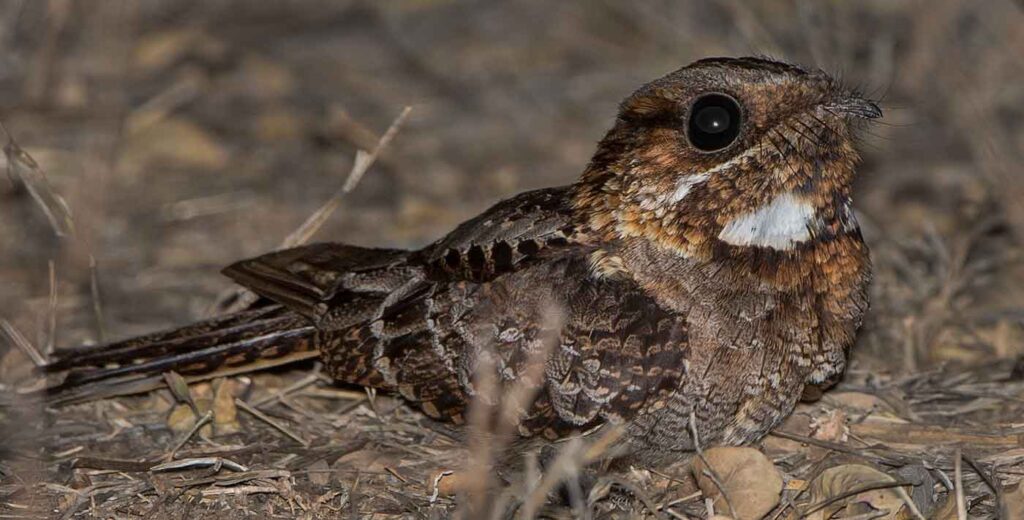
There is one other feature that is unique to Fiery-necks that was first highlighted by Greg Davies – the pale creamy colour to the base of the rictal bristles. A good feature if the bird is very close, or in the hand.

Fiery-necked Nightjar identification not too difficult if you get a good enough look at the bird.
Telling Rufous-cheeked & Square-tailed Nightjars apart
Having dealt with Fiery-necked ID, any other brownish, any brownish, or rufous-blotched nightjars you encounter (out of Pennant-winged distribution region) that don’t have rich brown mottled cheeks/lores is likely to be either Rufous-cheeked or Square-tailed. The large, swift flying European Nightjars are mostly greyish plumaged.
To be quite blunt, the two species dealt with here have ridiculous vernacular names – there to confuse all beginners!! Like most nightjars.
Assuming no birds are calling, the first species, Rufous-cheeked, has rufous to the LOWER cheek and neck region, lacking rich rufous plumage to the ear-coverts and lores (as in Fiery-necked).
Below: When perched, male and female Rufous-cheeked Nightjars are usually almost inseparable. The bird below was photographed in the Caprivi (Sept).

Below: By the end of the year, and end of breeding season, nightjars, like most birds in the region are in worn, frayed and bleached plumage, as with the Rufous-cheeked below that shows a very dull rufous neck patch. This bird was photographed in the Zambezi valley in mid-December.
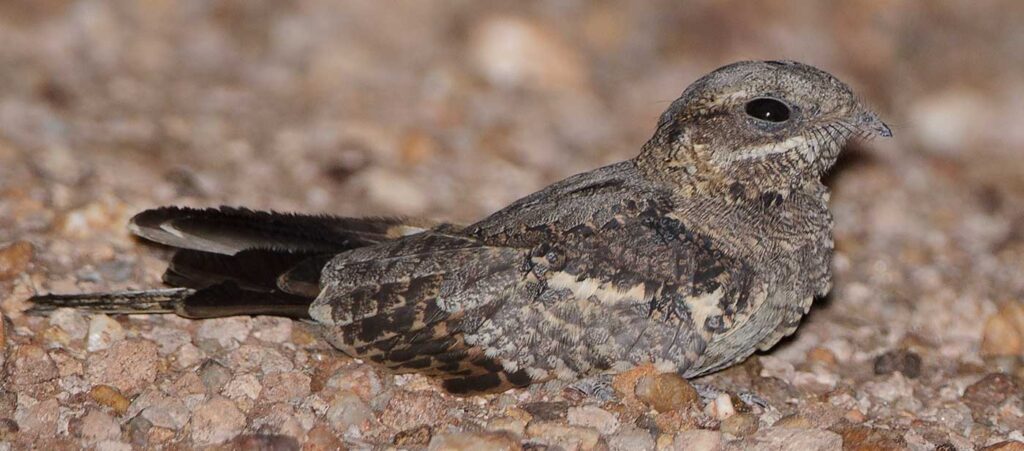
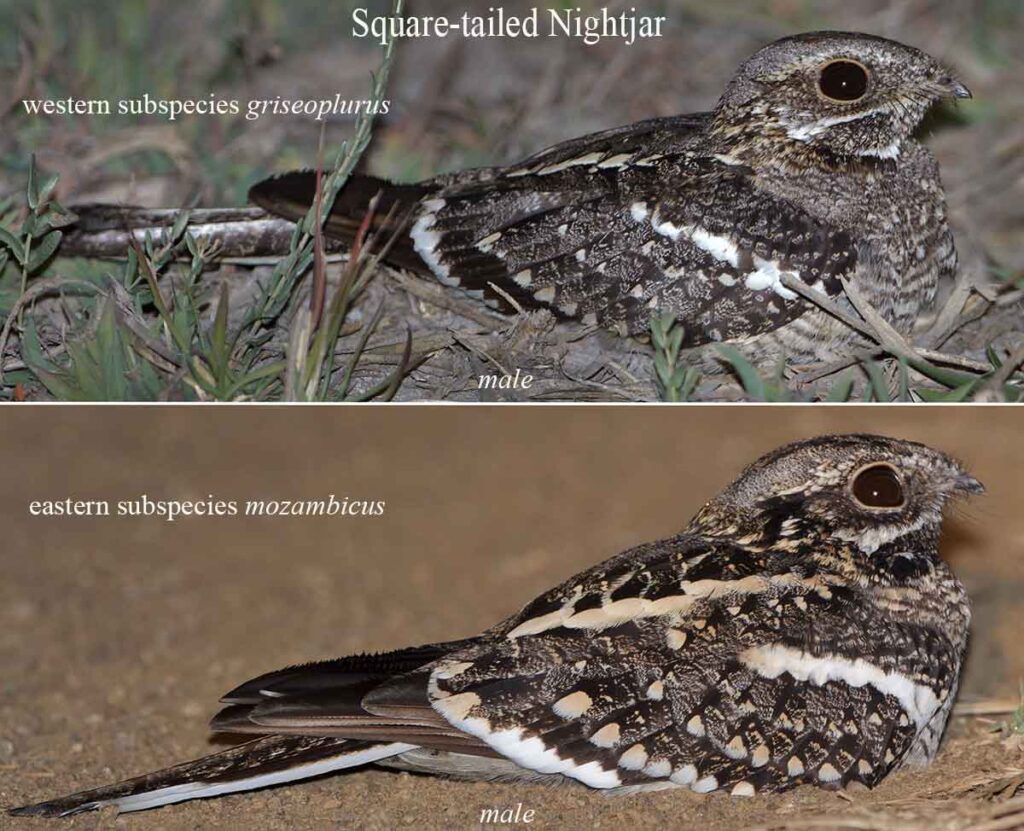
The name ‘Square-tailed’ Nightjar was probably coined by some bored taxonomist who’d never seen the species infield, so decided to take his frustrations out on the rest of us – forever! Unlike the above species, they are sexually dimorphic, males usually easily identifiable by the row of prominent white-tipped secondaries.

In spite of subspecies plumage variation, the characteristic row of white-tipped secondaries and white outer tail are good in-field features, no matter where you come across them.
Below: To deviate somewhat from in-field identification, Square-tailed wing spreads show male and female white spot differences.
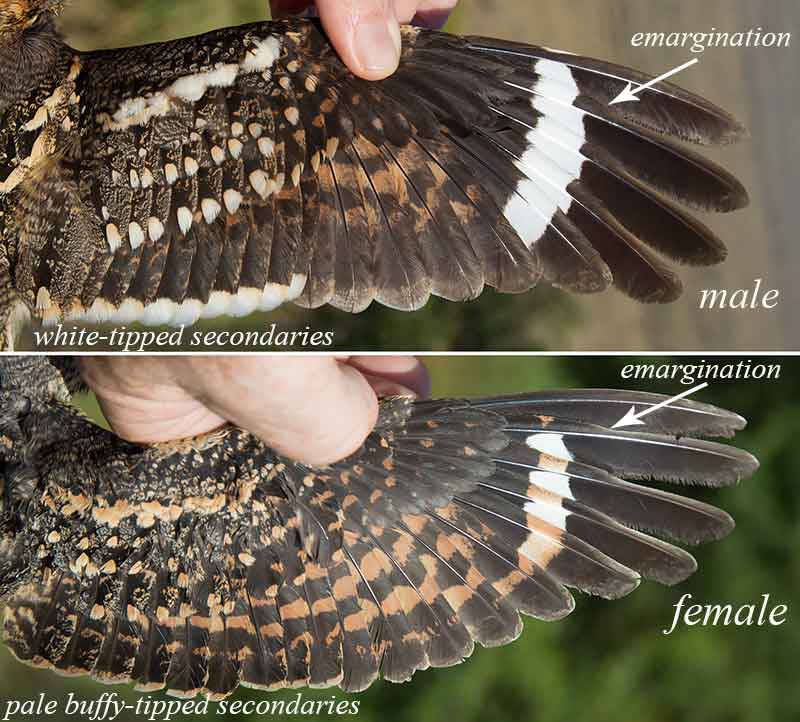
In-hand identification of the following three species is pretty simple if the white spot on the leading edge of the second (front) wing feather is examined.
Fiery-necked – white spot is positioned on the emargination (kink on the leading edge) of the P9 feather.
Rufous-cheeked – white spot is positioned immediately above the emargination (kink on the leading edge) of the P9 feather.
Square-tailed – white spot is positioned well above the emargination (kink on the leading edge) of the P9 feather.

Both Swamp and Freckled nightjars are easy to identify in-field
Swamp Nightjar
The habitat niche for Swamp Nightjar is damp lowland grassland, and you’d probably think that for the most part, it would be alone in that habitat. Not so, European, Square-tailed and Fiery-necked all occupy the same insect rich regions, the latter sometimes within meters of Swamp Nightjars.
Below: Swamp Nightjar is the only species that has conspicuous bold black ‘diamond’ like markings on itswing coverts and back (dorsal region), making identification fairly simple if the birds aren’t calling. They are represented by two different colour forms in southern Africa. The darker, more rufous/brown subspecies natalensis occupies the eastern coastal lowland regions.

Below: Its northern counterpart is found in the margins of the swampy Caprivi and Okavango drainage systems. This is a paler, greyer subspecies (carpi).

As with other nightjars, no nest is constructed, eggs are laid either on a pad of grass, or on the bare ground below a grass tuft.
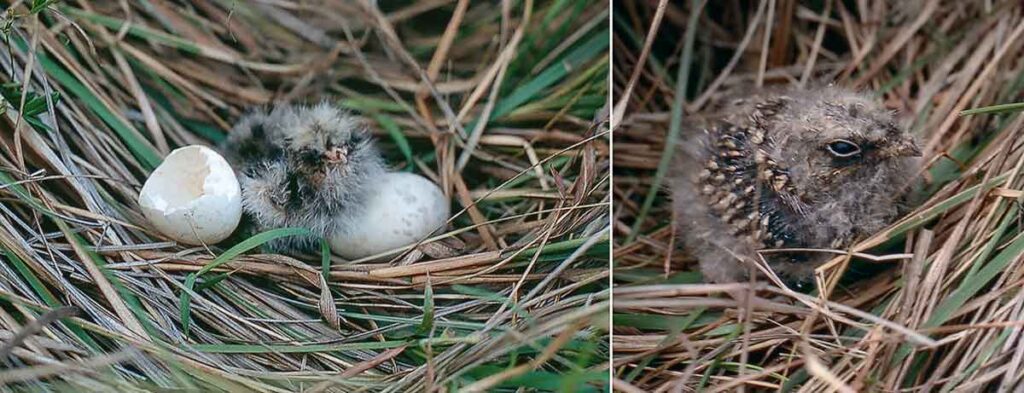
Freckled Nightjar
Freckled Nightjar is another species that is uniquely plumaged, distinctive & easy to identify.
Below: This darker eastern subspecies granosus was photographed in March, KNP.
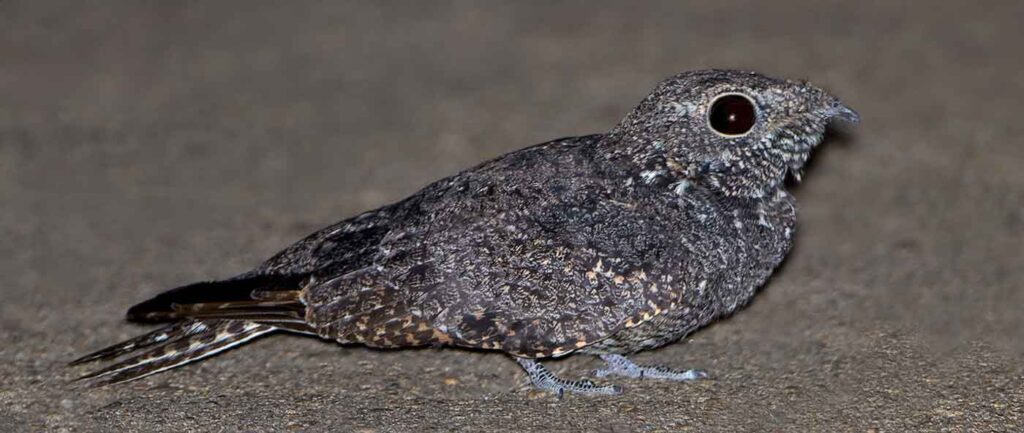
Below: The western subspecies lentiginosus is found in the western half of southern Africa where the rock formations tend to be browner (less blackish) than in some of the eastern regions. This bird was photographed in September at Kamanjab in Namibia.

All nightjars and their chicks are cryptically plumaged, but the chicks of Freckled Nightjar stand out as being superbly camouflaged, so much so that one has to cautiously and slowly inspect the rock below your feet with each step you take when you suspect Freckled Nightjars are breeding nearby! Richard Peek from the western Motopos of Zimbabwe who photographed the following two nest sites, kindly allowed me to include the following images.
Below: Two chicks on lichen-covered rock.

…and three chicks at the next nest site.

Magnificent birds, all of them.
Hugh Chittenden