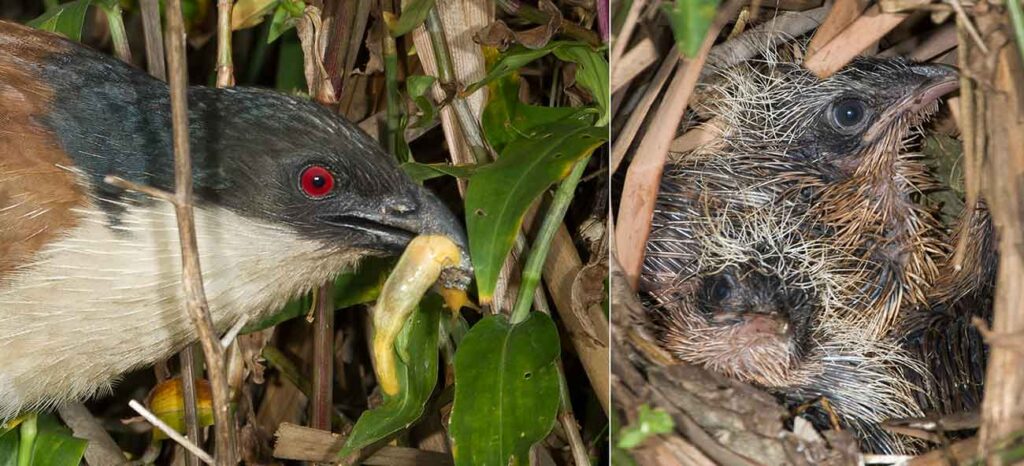
By Hugh Chittenden – Welcome to the world of weird things, trichoptiles, the strange hair-like protrusions on newly hatched coucal chicks.
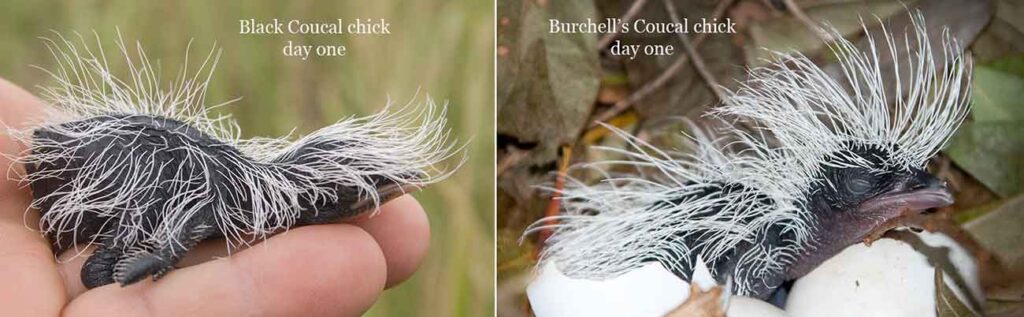
I’ve been trying to get my head around the function of coucal trichoptiles. Being almost ground level breeders, two of the main predators of coucal chicks would be mongoose and snakes. But those spiky white wire-like protrusions may just make the chick look inedible and deter some predators.
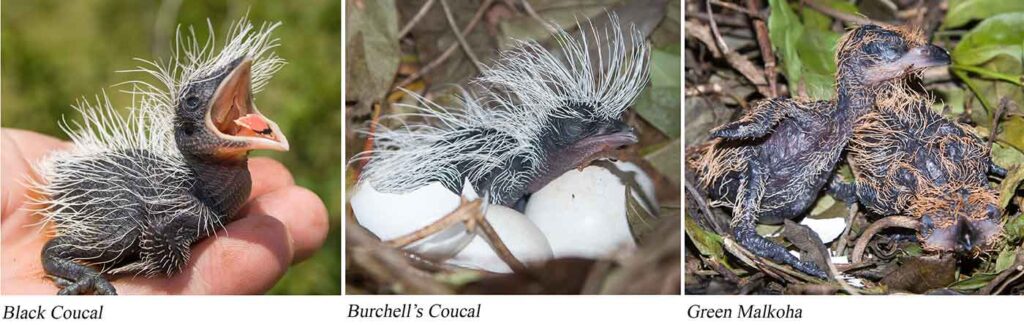
Green Malkoha chicks are also covered with trichoptiles but present differently in colour compared to those of coucals.
Interestingly, as opposed to mousebirds and their use of insecticidal leaves, coucals seem to only line their nests with green leaves during the incubation (not nestling) period. I have observed that the Black coucal brought guava leaves to the nest. These leaves are probably there to humidify the eggs during the incubation period and are unlikely to be placed for their insecticidal properties.


Getting back to trichoptiles, to me they are just evolutionary traits from a prehistorical era and nowadays serve no real function, but I could be completely wrong. They don’t remain that long though as these wiry-like appendages are just the tips to developing quills that push through after a few days, soon developing into feathers. So, coucal chicks don’t have soft down, they simply move from that spiky state, to quills and then to feathers.

To me, they look far more menacing at the quilled stage And what fantastic garden birds to have, they relish the slugs you detest!
Moving on from these strange spiky protrusions, Black Coucal is definitely one of my favourite birds, probably because we know so little about this rare species. When you hear it’s monotonous ‘choc, choc, choc’ call in November, you’ll know this rare migrant is back in town and the hot summer months are at your doorstep! It’s also interesting that they can breed before attaining full adult plumage.
And of course, they are normally polyandrous (male assumes most parental duties, including the incubation of eggs). At this nest, two birds were seen feeding the chicks, this was the other bird in attendance.
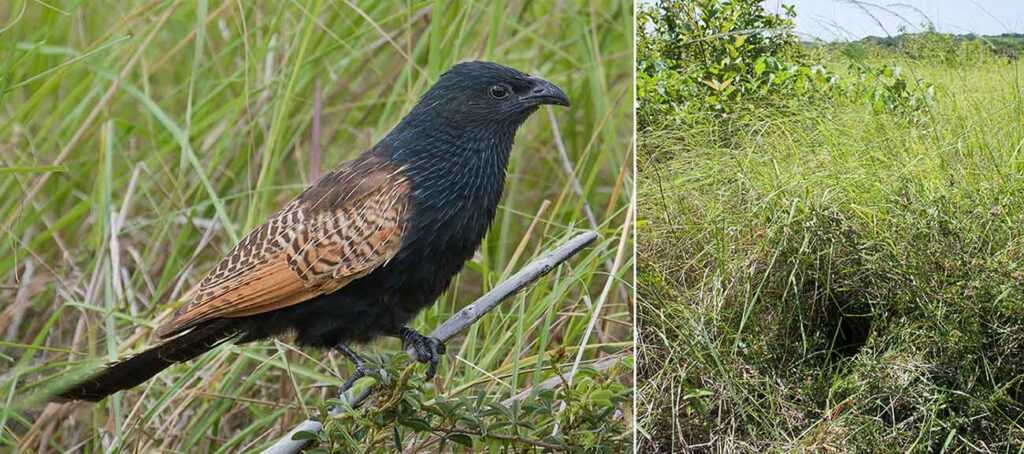
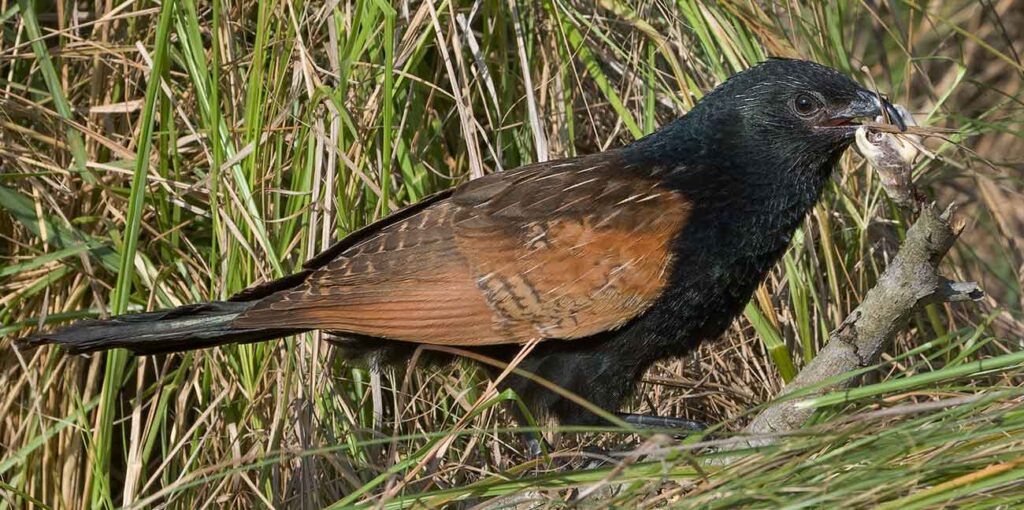
All the above Black Coucal bird photos were taken in 2005 at La Mercy, exactly where the King Shaka airport is today. In fact the nest was about where the main run-way was constructed the following year!
The bird below was photographed on the St Lucia western shores, and this brings me to the following point. Black coucals need dense, almost moist waist-high grass in which to breed. The sparse, shortish grass dominated by Cottonwool Grass Imperata cylindrica, found on the rolling dunes close to the ocean in north-eastern KZN (and Mozambique), is unsuitable for them in which to breed. It is just too sparse as they need to be able to duck into, and hide under a thick mat of grass when threatened by aerial (and other) predators.
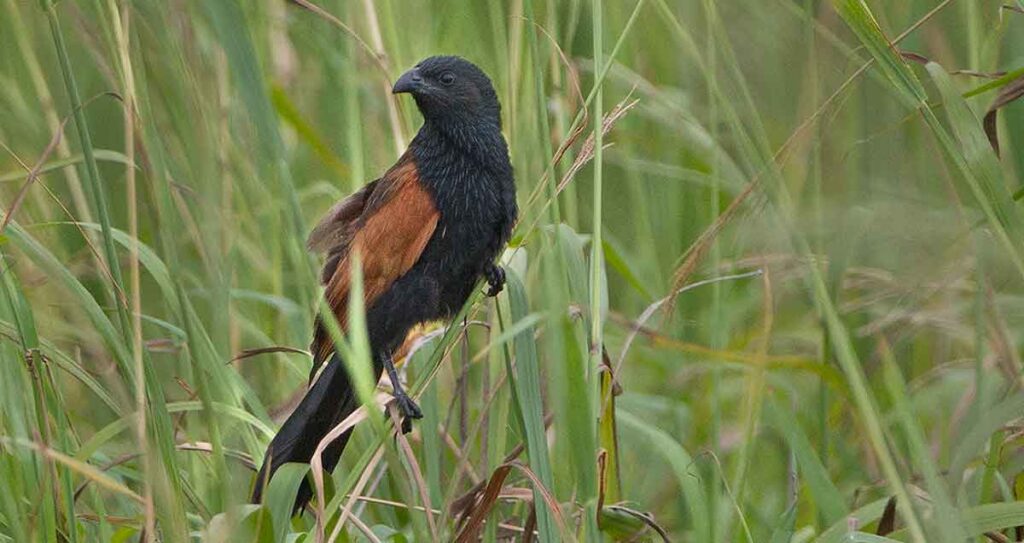
I thank Geoff Nichols for alerting me to the presence of breeding Black Coucals at La Mercy in 2005.